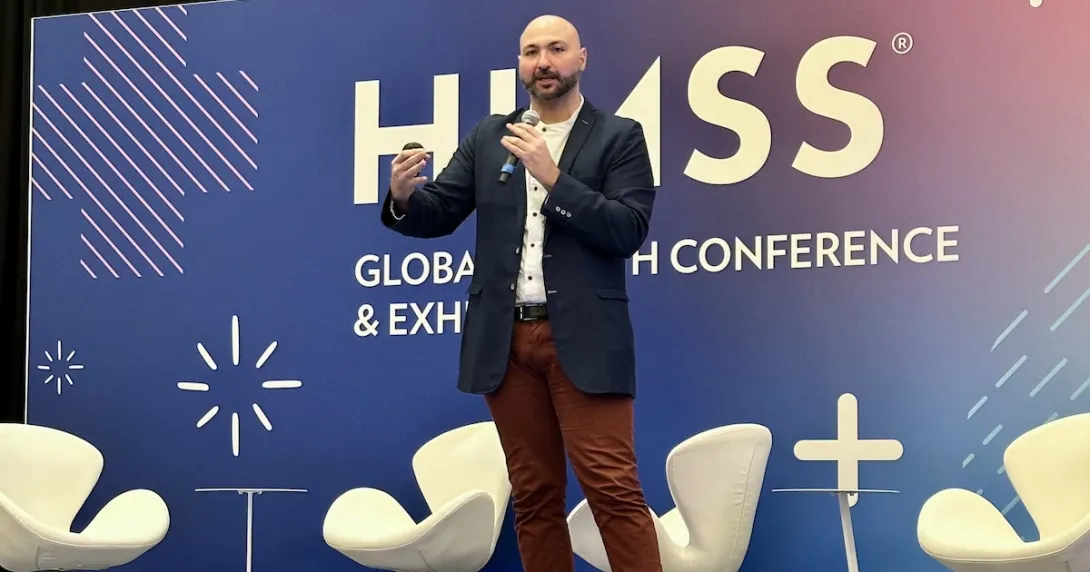
Dr. Guido Giunti, chief data officer at St. James's Hospital Dublin
Photo courtesy of Nathan Eddy
LAS VEGAS – During the 2026 HIMSS Global Health Conference & Exposition here last week, Dr. Guido Giunti, chief data officer at St. James's Hospital Dublin, said hospitals are investing heavily in artificial intelligence, but technology alone won't determine whether those efforts succeed; the real challenge lies in preparing the workforce.
This requires building the digital literacy, governance frameworks and leadership alignment needed to translate AI capability into operational impact, Giunti said.
During his talk, Giunti argued that sustainable digital transformation must begin with people rather than platforms.
Without structured programs that improve data and AI literacy across clinical and administrative teams, hospitals risk creating a widening gap between AI ambition and real-world outcomes, he said.
The scale of the challenge is significant. St. James's Hospital, Ireland's largest academic teaching hospital, employs roughly 5,400 staff and operates more than 1,000 beds.
Behind the scenes, its technology infrastructure includes roughly 12,000 devices, 4,000 PCs, more than 300 servers and more than 220 IT services supported by an IT staff of just 54.
Like many hospitals, the organization must make difficult decisions about how to allocate limited resources, Giunti said. Leadership often faces a choice between investing in clinical staffing or expanding technical teams.
"If senior management has to decide between one more nurse or one more engineer, they will pick the nurse," he said.
At the same time, European healthcare organizations operate within an increasingly complex regulatory environment. Hospitals must also contend with persistent interoperability challenges, uneven data quality and aging infrastructure, often while trying to modernize workflows built on legacy systems.
Despite those obstacles, Giunti said there are opportunities for health systems willing to invest in structured transformation strategies. Academic partnerships, national electronic health record initiatives, and expanding cloud and AI capabilities are helping create a foundation for progress.
The SUSA Consortium project, for example, focuses on closing digital skills gaps across healthcare through interdisciplinary training programs, defining 20 learning objectives covering areas such as data science and analytics, AI, cybersecurity, healthcare IT architecture, regulation and global health.
The goal is to give healthcare professionals a broader understanding of how data flows through clinical systems and how emerging technologies influence care delivery.
"We need to recognize how data flows in healthcare systems," Giunti said, noting that global mobility and diverse patient populations also require systems designed with accessibility and inclusivity in mind.
To help organizations assess their digital readiness, Giunti highlighted the Adoption Model for Analytics Maturity (AMAM), a framework developed by HIMSS that evaluates how effectively health systems use data to guide decision-making. The seven-level model provides a roadmap for advancing from basic analytics capabilities to more mature, evidence-driven operations.
At St. James's Hospital, an AI literacy program includes awareness campaigns, hands-on "AI clinics," structured training pathways and designated AI champions within departments. The aim is to build baseline digital literacy across both clinical and non-clinical staff.
"You can empower people by creating structured pathways they can work through and advance," Giunti said.
Educating staff also allows clinicians and administrators to ask more informed questions when evaluating new technologies, including whether vendors can support capabilities such as internet of things (IoT) integration or clinical-grade accuracy in tools like ambient documentation systems.
"Let's create a shared understanding between all of our stakeholders," Giunti said.
Those conversations can take time, but they are critical for building confidence among users. Without that trust, even promising technologies are unlikely to succeed in real-world environments.
"To create an empowered workforce, you need to make it simple," he said. "And we need to prepare for the long run – it's not a sprint, it’s a marathon."