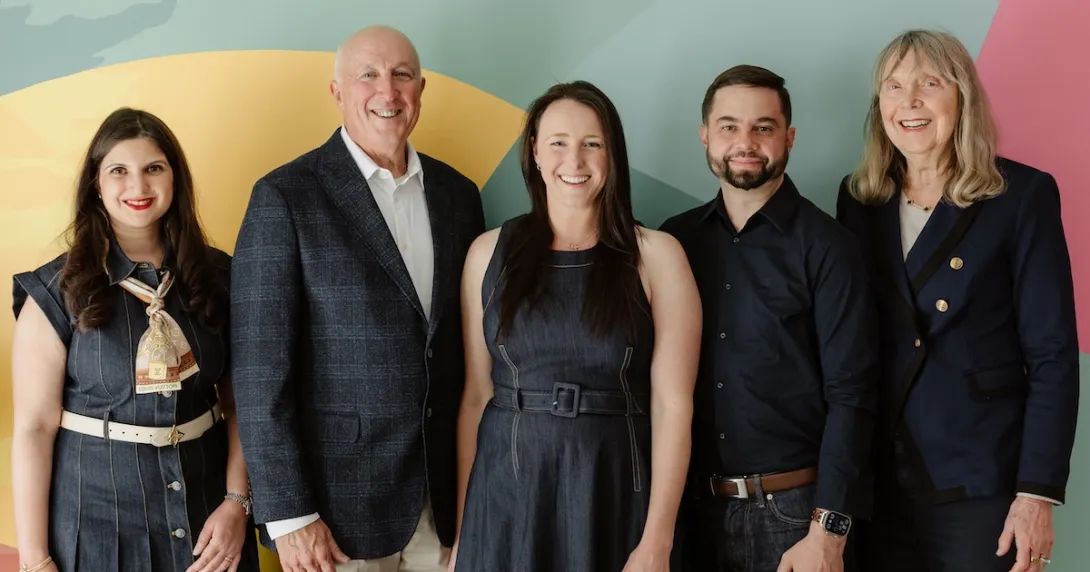
Treehub’s founding investment partners from left to right: Dr. Roxana Daneshjou, Derek Minno, Mary Minno, Dr. Alexander Ioannidis, Esther Wojcicki
Photo courtesy of Treehub
Palo Alto-based Treehub, a Stanford-adjacent residency program backed by the AI Health Fund, announced its launch Wednesday. The organization will identify and invest in early-stage founders arising from academia to bridge the gap between scientific discovery and VC-backed companies.
A network of prominent investors supports Treehub, including billionaire venture capitalist Tim Draper and 23andMe cofounder Anne Wojcicki, who joins as an operating partner.
Mary Minno, founding partner of Treehub and a former venture-backed founder and product executive at Google, and Esther Wojcicki, founding advisor of Treehub and the Palo Alto High School teacher whose classroom helped shape a generation of Silicon Valley founders, sat down with MobiHealthNews about the organization's launch.
Often referred to as the "Godmother of Silicon Valley," Esther Wojcicki is the mother of the late YouTube CEO Susan Wojcicki – in whose garage Google was founded – and 23andMe's Anne Wojcicki.
MobiHealthNews: Can you tell our readers about Treehub?
Mary Minno: We are excited to announce Treehub by the AI Health Fund. Treehub is a residency program for the best and brightest builders out of academic circles. So, these are folks using AI to improve our health systems.
We think about health as much more broad than just healthcare; we're very expansive in our definition of AI and health. If it's computational, if it has something to do with wellness, in general, we're interested.
Esther Wojcicki: That's the main thing, we are trying to help crucial points in the healthcare system, so that we can help the most people as possible, and so that maybe we can take care of some of their concerns online, so that then they don't have to clog up the appointments with the doctors and so forth. Whatever we can do to help – and so one of the things that we're very interested in is fertility issues because that takes up a lot of doctor visits, and if we can help people with their pregnancy and fertility issues, that will be a big deal.
Minno: One of the really exciting things is that AI is making possible real solutions to address the drag that currently exists in the medical system. There's only so much infrastructure, and we all feel it when we're trying to get a new primary care doctor, an appointment with a specialist or get answers to our questions. There is just limited capacity.
So, what we're really excited about with AI is the ability to not only unlock access to people, but to do so in a democratized way so that the people who are in Arkansas can get access to the specialists in some of these major hubs that can help support them.
Wojcicki: Some of the other things that we'll maybe look at are sort of more primary care doctor things that take up a lot of time, and frequently, doctors are just imparting information to people, which they could actually get online instead of having to go make a trip to the doctor's office, and it's a lot of time and energy on their part and a lot of time and energy on the doctor's part. So, if we can help facilitate this, it'll make a big difference. So, that's what we're looking at.
Minno: There are things that have just been stuck in an academic setting, and we're pulling them out. We're giving them the initial capital, the access, the resources and the space ... to help them take flight faster because the world needs this.
MHN: Mary, you said that the next great healthcare company is probably not being built in a garage. What has changed since the days where companies were built in a garage?
Minno: So, I think that what has changed today is the components needed to build competitive products in today's day and age. When you think about how to solve these problems, it has to do a lot with data and data access and data management and sort of data manipulation in terms of the engineering of data.
The reason why we partner so closely with academic founders is because they've been thinking in an academic setting about the science of this. They've been looking at the different types of datasets that are available in an academic setting, and they've been building on top of those and leveraging those, and it's through that process in academia that often the unique insights start to become more clear.
So, what we care about when we look at founders, and we talk to a lot of founders about joining Treehub, is finding people with really unique insights.
We come in and we help with the how. How do we tell that story? How do we commercialize it? How do we build a cohesive user experience so that as a parent with a child who I want more support for, I can go [to their platform] and it can be a one-stop shop.
MHN: Esther, Google was built in your garage, right?
Wojcicki: It was built in my daughter's garage. The reason they wanted people to think it was my garage was because they were concerned with who was paying the mortgage. [Laughter]
MHN: [Laughter] And you are known as the "Godmother of Silicon Valley."
Wojcicki: Yes, that's true.
MHN: Google's founders, Larry Page and Sergey Brin, would steal food from your refrigerator, from what I've heard, and would soak in your hot tub without permission.
Wojcicki: That's right. They were busy stealing food.
Minno: The original free food was Esther's refrigerator.
Wojcicki: So, that resulted in the free food at Google. [Laughter]
MHN: [Laughter] So, you have seen technology grow substantially. Where do you see promise for technology in healthcare?
Wojcicki: I think it can make a huge impact on answering patients' questions accurately. Because a lot of people go to the doctor with the question, which could be solved by just an answer on a technical tool, and it would save a lot of time for those people and save a lot of time for the doctors. And so, there are already places out there that can do it.
If we could have a digital doctor answering your questions, kind of like, you know, you go to the doctor and say, "Well, this is what's happened at night, in the morning and how I feel," and the AI can answer those questions for you, that would save so much time for you personally and for the medical profession, because they should be able to see patients [where] the cure is not easily solved.
Normally, they see somebody, it's literally for 15 minutes, and then they give you a prescription, and then you run to the pharmacy, and then that's it. But getting to that 15 minutes takes usually an hour, and you're waiting, and it's bad for the doctor.
So, that's the main thing that I can see. And so, we want to have it happen quickly. I think this is the best way to do it.
MHN: Will AI Health Fund specifically focus on individuals being able to gain access to AI tools, or will it be more of a provider and consumer mix?
Wojcicki: Well, I would like to see big organizations … like Kaiser, for example. Kaiser is really, it's a great healthcare system, and if they could get AI that would answer your primary questions, it would take a lot of pressure off the doctors. I can just see that happening.
Minno: I'd say, just thinking about your question more broadly too, we are very expansive in how we think about investing. If it is AI plus health, and it's a brilliant founder with a unique insight, with a determination to make the world different and better for healthcare, we want to help them.
So, what Esther is describing is absolutely an area that we're excited about. The democratization of access to care is really important to us.
MHN: What stage is Treehub at today?
Minno: We launched Treehub on Monday [April 13].
Wojcicki: Brand new.
Minno: Brand new. So, we're physically sitting in Treehub, which is a location in Los Altos. The AI Health Fund has invested in 12 companies so far since October, and we're off to the races.
We really see this in the same way that Esther has taught me to approach everything. I was her former student; she was my high school journalism teacher. I am the living product of what she preaches. I showed up at her house this morning, and we were joking about that. I said, "You're responsible for this, Esther. You made me the way I am."
And we see this as an experiment, right? It's like, we've started with six companies for the first cohort. Our goal is to scale this. Is six the right number? No, we want it to be more, but we want to start with six because we want every company to be successful. We don't want this to be like the traditional venture model, where 80% of the companies fail.
We want to focus the way Esther has focused on making her students successful. We want to make our founders successful. So, it's starting with six. The next cohort will be bigger, and it will be bigger and bigger and bigger until we figure out when we can't do more, and then we'll add more resources to figure out how to do more and grow until we are all comfortable with the state of the healthcare system.
Wojcicki: This healthcare system has a lot of areas for improvement, and so we have a lot of things to do.
We can also help companies or doctors that are supported by private healthcare companies, like Blue Cross Blue Shield. So, I mean, everybody's out trying to save time, money, energy, and, you know, it's a crazy system out there right now.
MHN: You both sound very excited. Is there anything that makes you nervous? Is there any technology that makes you nervous?
Minno: What I would say is, like, I think that healthcare is an inherently exclusionary community. Like, you have to have a degree to do certain things, and I think there's advantages to that, right? There's a level of thoughtfulness and reps that go into getting your M.D., and so for us, it was really important to have the right partners at the table.
Esther and I have teamed up with two faculty members from Stanford's biomedical data science group that are deeply embedded in this. They're part of the School of Medicine. And so, everyone that we bring in to surround these companies is to help make sure that the technology they develop is done with the lens of doing good and doing it in the right way. This isn't a 'move fast and break things' industry; this is a 'move fast and fix things' industry.
Wojcicki: Yeah, move fast, fix things and revise. So, the move fast and break things was ... actually [Mark Zuckerberg] stole it from me.
MHN: Did he?
Wojcicki: Yes! It was move fast and revise. And the break things was ... he was like, move fast, break it – he forgot to put the revise in, because that is what you do. You don't just break it and then just leave it there and go away. You fix it. And so, anyway, just so you know, for your own information or whatever – revise is part of the deal.
Minno: Revise is huge here. We're helping our founders iterate until they get it right. So, there's no preemptive scaling. It's how do we make sure that we're doing this in a way that is advantageous to society and to humans, right? The people who are going to be experiencing all of this technology. It has to be done the right way.
Wojcicki: The only thing that makes me nervous is the statistics. If you look at startup statistics, 90% fail. Ninety. And so, we're trying to break that in half, at least. And the main reason those startups fail is the people that founded it start to fight with each other, unfortunately. So, it's a lot of backstabbing and things. So, we're hoping to prevent all of that. Teaching people how to get along with each other is really important.
I have this TRICK model that I use in schools and parenting, and we're using it in corporations, and it works at Google, by the way. So, we want to teach people how to work together in an effective way. Even if you don't agree with something that's being done, don't just sit there and suffer. Say something about it.
MHN: Right. Say something about it, and explain to me why you don't agree with it, because maybe I'm not thinking about it like that.
Wojcicki: That's right. That's right. People need to learn that. Unfortunately, they don't learn that in school, because schools are like, you know, you take a test, you have to do it by yourself.
There's a lack of collaboration, a lack of understanding; we're trying to get rid of that training that they had in the schools.
TRICK stands for Trust, Respect, Independence, Collaboration and Kindness. It belongs in all companies, all relationships, actually, with your spouse as well. TRICK does the trick.