Photo courtesy of Heidi
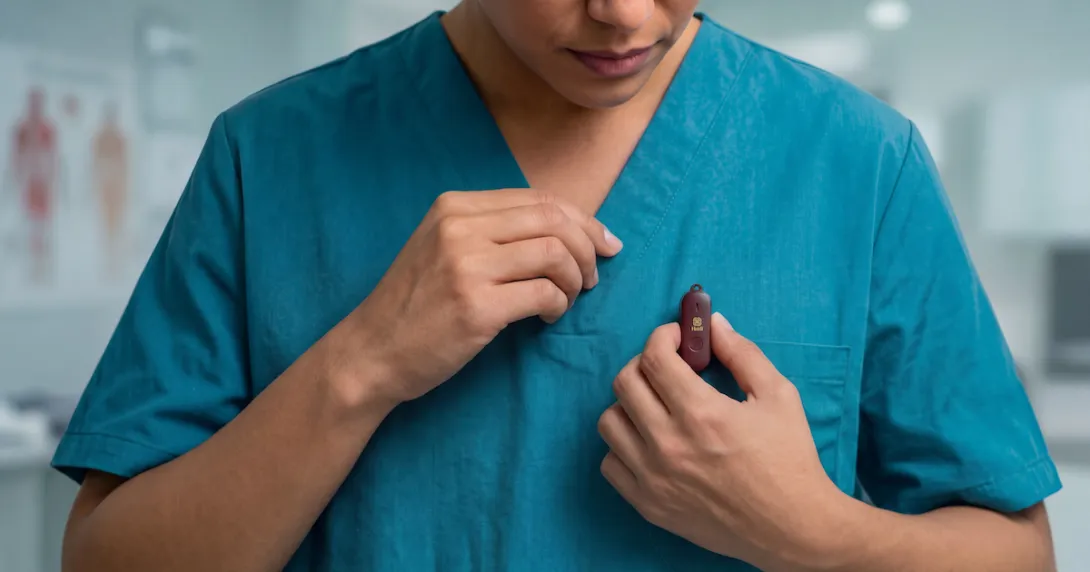
Heidi has launched a wearable microphone designed to provide clinicians with reliable audio capture for AI-assisted documentation without using phones or laptops.
WHAT IT DOES
Intended to support the Heidi AI Scribe, the new Heidi Remote enables consistent audio capture in noisy environments. Weighing 21 grams and offering up to 14 hours of battery life, it can be clipped onto clinical attire for use throughout a full workday.
The device operates independently of phone battery and Wi-Fi connectivity, allowing consultations to be captured offline and synced later when a connection is available.
Heidi also said the device is built for frequent disinfecting and meets healthcare security standards, with all data encrypted.
Heidi Remote will initially be available in Australia, New Zealand, the United Kingdom, the United States, and Canada, with the European Union to follow shortly.
WHY IT MATTERS
As the use of AI scribes is increasingly becoming a standard in clinical documentation, the "weakest link" has always been the device in the room, said CEO Dr Thomas Kelly.
Heidi built its own microphone after finding that existing consumer and third-party devices place what co-founder and CTO Yu Liu described as an "integration tax" when applied to specialised clinical workflows.
"We found it nearly impossible to achieve a seamless experience using third-party software stacks," he told Mobihealth News.
Integrating external hardware would have required redesigning core software around vendor constraints while creating risks to stability as systems on either side upgrade, he added.
Heidi said clinical environments were never designed for AI listening, pointing to ageing computer terminals, shared workstations, and personal smartphones that were not built to support AI-assisted care.
The company opted for a wearable microphone instead of room-based or fixed systems to better support clinical work across varied and mobile settings.
"Clinical care isn't static," Liu said, noting that room-based systems and telehealth setups can fail in edge cases, such as ward rounds, high-mobility clinics, or rural settings with limited connectivity.
The CTO said the wearable form factor is intended to eliminate "workflow anxiety," ensuring consistent audio capture despite noise, movement, and inconsistent device performance.
THE LARGER TREND
Heidi Remote is the company's first venture into hardware as it evolves beyond AI scribe into a broader clinical workflow platform that includes documentation, evidence retrieval, and patient communications tools.
It followed the launch of Heidi Evidence, introduced in February, an ad-free medical research tool on its AI Scribe, and Heidi Comms, which assists with coordinating patient communications across calls, bookings, reminders and follow-ups.
ON THE RECORD
"Clinicians shouldn't have to wonder if a room-based microphone will catch the audio or if a spotty internet connection will disrupt their notes… Whether a clinician is in a high-tech metro hospital or a remote clinic, Heidi Remote provides the same reliable performance, solving for mobility and connectivity gaps that fixed infrastructure simply cannot," co-founder and CTO Yu Liu told this publication.