Photo courtesy of the National University of Singapore
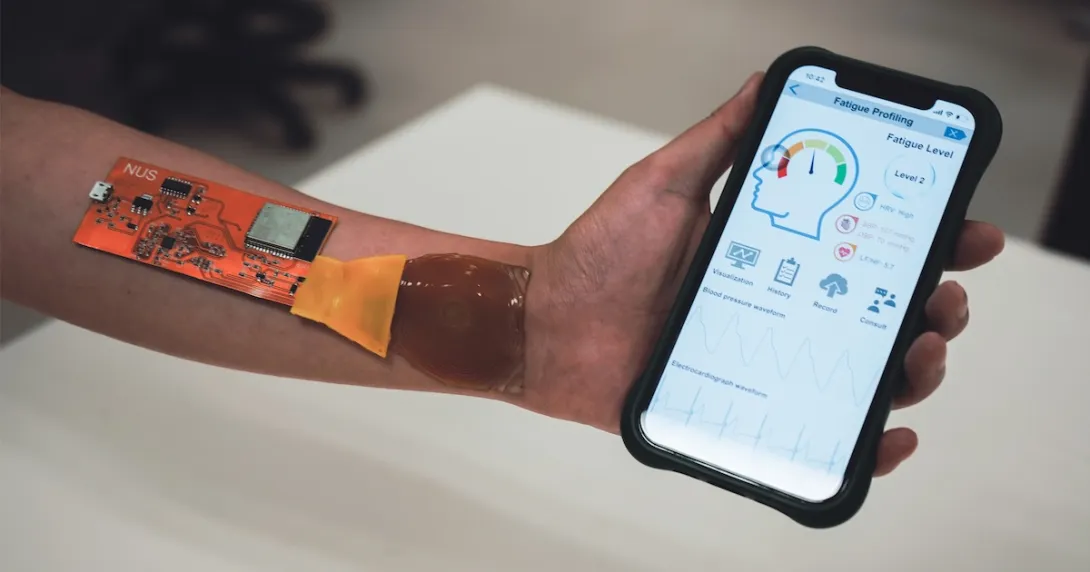
Researchers from the National University of Singapore have developed an AI-powered smart sensor platform that can clearly detect fatigue.
HOW IT WORKS
Fatigue, which disrupts the autonomic nervous system, leaves measurable traces in heart rate variability, blood pressure patterns and ECG waveform features.
To capture these signals reliably, the metahydrogel-based sensor platform was designed with two filtering mechanisms: a nanoparticle-based structure that absorbs and dampens movement-related vibrations, and a liquid component that allows key heart signals to pass through while filtering out unwanted noise.
A machine learning denoising algorithm then further cleans up any remaining interference while preserving important physiological signals.
The research team described the sensor platform as soft like biological tissue, as well as breathable and durable.
To train the fatigue detection model, the team collected physiological signals continuously captured from participants during various activities, including simulated driving tasks. This data was then paired with validated fatigue assessment scores to create labelled training data, allowing the system to learn patterns associated with fatigue and apply them to new users.
FINDINGS
Based on findings published in Nature Sensors, the system identified fatigue with 92% accuracy – up from 64% without the metahydrogel sensor – indicating potential for continuous mental health monitoring in real-world settings, according to the research team.
It achieved an ECG signal-to-noise ratio of about 37 decibels (dB) during movement and a blood pressure deviation of around 3 millimetres of mercury, meeting ISO clinical-grade standards. The researchers said this exceeds performance typically reported for consumer smartwatches, although no direct device-level comparisons were provided.
"Current smartwatches typically achieve ECG signal-to-noise ratios of 10-20 dB, which can decrease by approximately 40% under motion due to artefacts and unstable contact. Our system achieves around 37 dB during daily activities," Dr Tian Guo, the study's first author, was quoted in a media release as explaining.
Beyond fatigue tracking, the system was also able to reduce noise in a range of body signals, including heart and breathing sounds, voice, brain activity and eye movements.
WHY IT MATTERS
Fatigue and mental health issues are increasingly recognised as serious public health concerns, affecting not only individual well-being but also cognitive performance, decision-making, productivity, and safety in everyday settings.
Unlike many physical conditions, these states often develop gradually and without obvious symptoms. Subtle physiological changes, particularly in cardiovascular signals linked to the autonomic nervous system, can occur before individuals become aware of fatigue or stress. However, current assessments still rely largely on self-reported questionnaires, which are subjective and intermittent.
This gap in objective, real-time assessment drove the NUS study.
"Rather than relying solely on software to clean up noisy data, the team tackled the problem at the sensor-body interface itself," NUS noted in a media release.
In an interview with Mobihealth News, Dr Tian explained that software-based signal processing "typically works after noise has already entered the system," which makes it difficult to remove motion artefacts without affecting the underlying physiological signals.
He noted that many existing algorithms also "lack sufficient selectivity," often suppressing meaningful signals alongside noise, particularly in real-world conditions where signals are weak and dynamic.
"By engineering the material at the bioelectronic interface, we aim to selectively attenuate mechanical and electrophysiological artefacts before they propagate through the system. In this way, software and AI can operate on cleaner input signals from the outset, rather than attempting to recover information after it has already been degraded."
"By capturing real-time, dynamic signals directly from the body, it becomes possible to move from episodic, perception-based assessment to a more objective and continuous understanding of mental and physiological states," added the study lead, Prof Ho Ghim Wei.
The work builds on about four years of research, with the past two years focused on developing the metahydrogel approach, followed by system integration and validation for real-world use cases.
Now, the research team is further developing the system by working with mental health specialists to identify the most relevant physiological signals and the accuracy needed for clinical use.
"Looking ahead, scaling the dataset remains a key priority. Ongoing and future efforts will focus on expanding participant numbers, increasing demographic diversity, and incorporating a broader range of real-world and occupational scenarios," Prof Tian told this publication.
The team is also seeking industry partners to refine the sensing platform and scale it into a product.
"While the platform is still at a research stage, our immediate efforts are directed towards manufacturability, clinical interpretability, and large-scale validation," Prof Ho added.
THE LARGER TREND
Earlier research at NUS also explored alternative approaches to continuous health monitoring, including a wearable hydrogel-based sensor that detects solid-state biomarkers such as cholesterol and lactate directly from the skin without relying on blood or sweat.
Another 2024 study in China developed a coin-sized continuous glucose monitoring system based on an organic electrochemical transistor that showed comparable sensitivity to the Dexcom G6.