Photo courtesy of Sky Labs
South Korean company Sky Labs is pushing cuffless, ring-type blood pressure monitoring into hospital wards, working to automate routine vital sign checks.
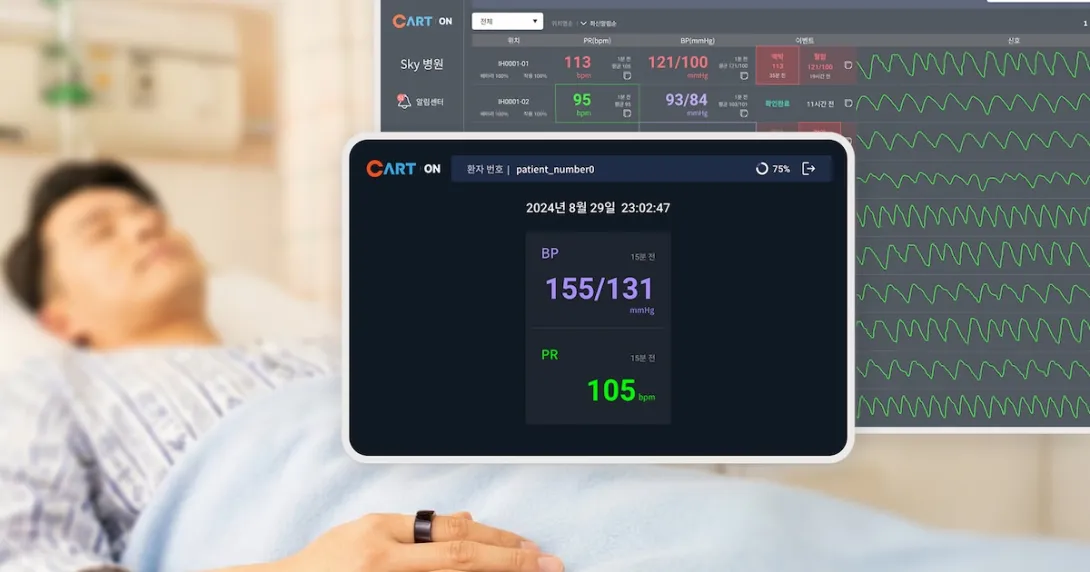
Recently, it launched the CART ON system, which it claimed to be the world's first BP ring for ward use.
HOW IT WORKS
Indicated for patients requiring 24-hour ambulatory BP monitoring, the ring features a photoplethysmography (PPG) sensor that automatically measures a patient's BP. That data, linked with Seers Technology's inpatient monitoring platform, thynC, is then automatically transmitted to and recorded in the nurse station dashboard and a hospital's EMR system.
Based on clinical studies cited by Sky Labs, CART ON achieved a mean error within 5 mmHg and standard deviation within 8 mmHg versus auscultation and cuff-based ambulatory monitoring. According to the company, this means it produces BP readings comparable to standard auscultation and cuff-based ambulatory monitoring, meeting international validation criteria, including ISO and European Society of Hypertension criteria.
The device's algorithms, trained on invasive arterial line data, also maintained accuracy across different blood pressure ranges and during periods of fluctuation, indicating potential use for continuous monitoring.
WHY IT MATTERS
Routine BP monitoring remains labour-intensive in hospital wards. In South Korea, for example, a single nurse typically manages 12 to 16 patients – and up to 20 in some settings – while performing up to nearly 100 manual cuff measurements per day, according to government data and industry surveys.
Sky Labs is proposing CART ON as an automation tool to reduce repetitive bedside checks and manual data entry, ultimately helping minimise documentation errors and free up nursing time for higher-value clinical tasks.
"For instance, if a nurse managing 15 general patients replaces four manual checks per patient with this system, approximately 60 manual measurements can be automated daily," the company told Mobihealth News in an emailed response.
Additionally, the use of Sky Labs' BP ring has shown potential to reduce patient discomfort, movement restrictions, and nighttime disruptions in shared ward environments.
"This not only ensures the collection of high-reliability nighttime blood pressure data but also contributes to maintaining a stable ward environment by preventing manual measurement rounds from disrupting the sleep patterns of fellow patients in multi-patient rooms," the company said.
This automation, added Sky Labs, aligns with broader efforts to transition towards a smart hospital system that emphasises labour efficiency and reducing operational gaps.
Korean pharmaceutical giant Daewoong Pharmaceutical, which currently holds exclusive sales rights for the technology, plans to supply CART onto hospital distribution networks nationwide.
THE LARGER CONTEXT
The ward-specific BP monitoring system adds to Sky Labs' lineup of BP ring-based solutions, completing an end-to-end blood pressure monitoring portfolio across consumer, outpatient, and inpatient settings. Earlier, in January, the company obtained the European Union Medical Device Regulation certification for its CART platform, covering the ring device, backend server, companion mobile app, and web-based viewer. Meanwhile, its outpatient system, CART BP Pro, has been prescribed across roughly 1,700 hospitals and clinics in South Korea since securing local insurance reimbursement in 2024.
Sky Labs has recently integrated its consumer BP ring device, CART BP, with Kakao Healthcare's AI-based PASTA platform, adding BP to other health metrics such as diet, exercise, sleep, and stress within a single app interface. In a media release, Sky Labs said this allows users to "more intuitively understand how different lifestyle patterns correlate with fluctuations in their blood pressure," helping them design and maintain management routines based on their specific needs.
The new service came following an agreement between the two companies in October last year and a 2022 memorandum of understanding. The addition of BP monitoring, according to Kakao Healthcare, expands PASTA into a comprehensive chronic disease management platform.