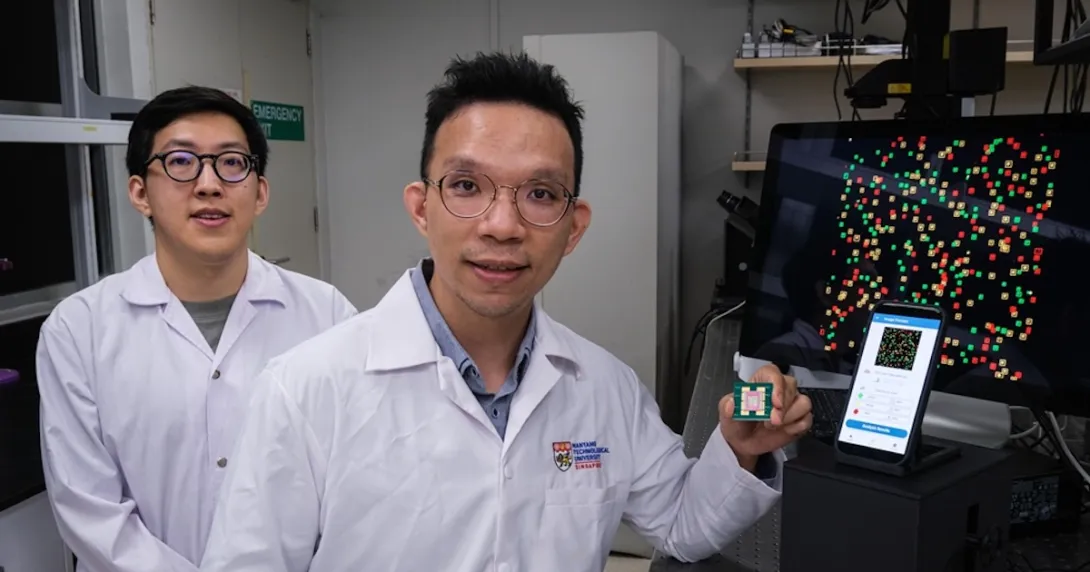
Photo courtesy of Nanyang Technological University
NTU Singapore develops AI microRNA detection chip
Scientists from the Nanyang Technological University (NTU) in Singapore have developed an AI-enabled biochip that can rapidly detect microRNA biomarkers from small biological samples.
The system combines a nanophotonic chip with AI-based image analysis to identify and classify thousands of microRNA signals from a single sample in about 20 minutes. It uses deep learning to automate detection and reduce reliance on PCR-based amplification and manual analysis.
Based on a media release, a prototype integrating a camera and mobile application has been built to support automated analysis. Early tests, whose findings have been published in Advanced Materials, demonstrated high sensitivity and accuracy across cancer-related microRNA targets, indicating potential applications in broader disease screening.
Neurophet raises $20M for expansion
South Korean company Neurophet has raised 32 billion won ($21.6 million) from institutional investors to support the expansion of its AI-based brain imaging analysis tools.
The funding, split evenly between convertible preferred shares and convertible bonds, will be used to scale its software suite and related services for diagnosing and monitoring conditions such as Alzheimer's disease. It will specifically fund its efforts to establish more partnerships with global pharma and hospitals and set up commercial infrastructure in the United States.
"With our new funds, we plan to conduct aggressive sales activities to proactively respond to the expansion of the treatment market and accelerate global business expansion in the US and Japan," said co-CEO Jake Junkil Been in a press statement.
Indonesia OKs AITRICS's patient monitoring AI
Another South Korean company, AITRICS, has received approval in Indonesia for its AI-based patient deterioration prediction solution.
This comes as Indonesia pushes the broad adoption of AI-based software as a medical device as part of its 2025-2029 Digital Health Transformation Strategy.
This is the company's fifth regular clearance for AITRICS-VC (VitalCare) after South Korea, the United States, Vietnam and Hong Kong. It is also working to get the software approved in Singapore and Thailand. The software analyses hospital EMR data to predict risks such as death, ICU transfer, cardiac arrest and sepsis in general wards, as well as mortality risk in intensive care units.
CUHK launches cancer subtyping AI tool
The Chinese University of Hong Kong (CUHK) has introduced an AI-powered diagnostic tool to classify oesophageal squamous cell carcinoma (ESCC) using routine pathology slides.
The tool, called imECMS, analyses standard H&E-stained slides to identify four molecular subtypes of ESCC by extracting spatial features, delivering results within minutes without the need for RNA sequencing or additional patient samples.
According to a media release, it builds on a newly established consensus molecular classification system developed from multi-omics data of 152 patients with ESCC, integrating eight prior subtyping models into a unified framework to guide more precise treatment planning.